


CORPIQ calls IRIS report on rents misleading
CORPIQ is denouncing what it considers misleading information published today in a report by the Institut de recherche et d'informations socio-économiques (IRIS), which claims that rents in Quebec are rising faster than tenants' incomes.

According to the report's author, Philippe Hurteau, the share of rent as a percentage of the average real pre-tax income of tenant households has been increasing since 2011. CORPIQ argues that this conclusion is misleading and based on flawed methodology.
“IRIS should have used the average after-tax income of tenant households. In addition, it compares tenants' income in 2017 with rental data from 2018,” explained Hans Brouillette, CORPIQ's Director of Public Affairs.
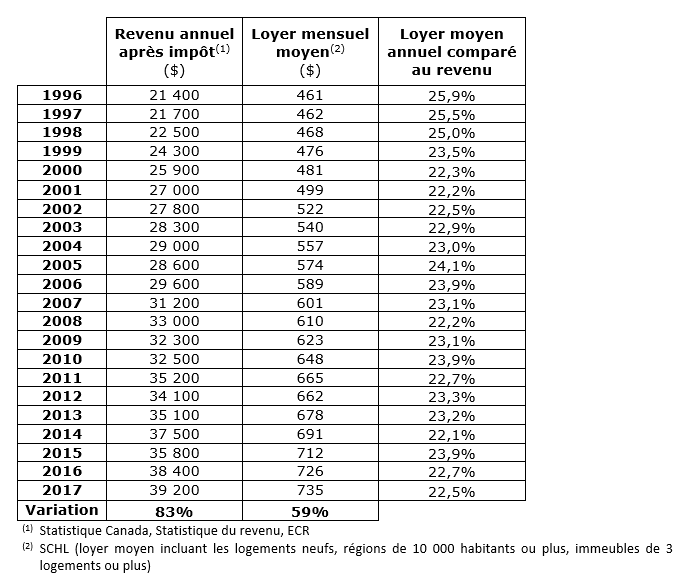
According to CORPIQ, the facts tell a different story. Statistics Canada reports that the average after-tax income of Quebec tenant households was $39,200 in 2017, while the Canada Mortgage and Housing Corporation (CMHC) reported an average monthly rent of $735 for the same year. On an annual basis, rent therefore represented 22.5% of after-tax income. In 2011, that figure was 22.7%.
“Twenty years ago, the average annual rent represented more than 25% of tenants' after-tax income. Overall, housing affordability has therefore improved in Quebec. This is a significant improvement, particularly given that many higher-income tenants have since become homeowners, while more than half of all tenants now choose to live alone,” continued Hans Brouillette.
CORPIQ also describes IRIS's analysis as overly simplistic for arguing that rents are rising faster than inflation and using this as justification for stricter rent controls by the Régie du logement.
“IRIS should recognize that you cannot compare rent increases with overall inflation without considering housing-specific inflation. For example, municipal property taxes in Montreal have increased by 30% since 2009—twice the rate of general inflation.”
“Since the 1990s, rents have increased by an average of 2% per year in the Montreal, Quebec City, and Gatineau regions. That figure includes newly built rental units, which naturally command much higher rents. At the same time, nearly half of all tenants have lived in their current unit for at least 10 years, meaning their rents have increased at a slower pace than average,” concluded the CORPIQ spokesperson.
Average after-tax income of economic families whose dwelling is not owned by any member of the household, Quebec.