



Creation of a Quebec Housing Observatory: understanding the real needs of Quebecers to better plan public policy
As a provincial election campaign gets underway and Quebec prepares to invest billions of dollars to address the housing crisis, the Corporation des propriétaires immobiliers du Québec (CORPIQ) is calling on all political parties to commit to creating a Quebec Housing Observatory. The objective is to establish a permanent body responsible for collecting reliable data on the current and future housing needs of the population in order to support the various ministries involved in housing policy. Such an institution would enable Quebec to better account for its unique characteristics and help prevent future housing crises.

A Housing Observatory to better inform public policy
CORPIQ believes that both public and private investments should be based on reliable, independent, and forward-looking data in order to build the right housing, in the right locations, at the right time, while equipping the various ministries involved in housing with better planning tools. CORPIQ proposes that the Observatory be mandated to:
- Make recommendations to better align demographic trends—such as immigration, population aging, and household formation—with public policy tools that encourage housing starts.
- Analyze changing regional demographic needs based on the economic and employment dynamics of each municipality.
- Produce local demographic projections to help municipalities plan infrastructure and residential development projects.
- Analyze the factors influencing housing costs (cost of living, construction and renovation material costs, labour costs, etc.) and recommend measures to reduce their impact on the population, particularly tenants.
- Analyze housing supply across the entire housing continuum and make recommendations to the Government of Quebec regarding support for each category of residents, especially the most vulnerable.
- Produce regular analyses of vacancy rates by region and municipality and make recommendations regarding housing starts for each housing type across the housing continuum.
Avoid simply shifting the problem
CORPIQ believes Quebec would benefit from a permanent organization capable of providing independent analysis, monitoring evolving housing needs across the entire housing continuum, and evaluating the impact of public policies.
Such an approach would also improve coordination of investments made by governments, municipalities, and the private sector, maximizing the value of every dollar invested.
According to CORPIQ, currently available housing data are fragmented or often outdated, making it difficult to develop coherent public policies tailored to Québec's reality. Recent debates surrounding vacancy rates, vacant housing, and construction targets clearly illustrate the need for consolidated data and common performance indicators.
We are making decisions today that will shape Québec for decades to come. We need to recognize the unique characteristics of Québec's housing model and gain a more detailed understanding of the population's needs, wherever they fall along the housing continuum. A Housing Observatory will help guide both public and private investment more effectively and avoid one-size-fits-all solutions that merely shift problems from one part of the housing continuum to another.
Nathalie Mercier, Executive Director.
More proposals to come
On June 17, CORPIQ released its report entitled Local landlords, pillars of our economy, which provides an unprecedented overview of Quebec's housing model. A second report will be published shortly, presenting recommendations on community living, preservation of the existing housing stock, and ownership succession.
Housing highlights
- In Québec, 96% of landlords are individuals.
- Forty-three percent own only one rental property.
- Thirty-nine percent are owner-occupants (54.3% in Montreal).
- One in four landlords must cover part of their operating expenses from sources of income other than their rental properties.
- Acquisition costs have increased dramatically across all housing types: 103% for single-family homes, 80% for plexes, 72% for condominiums.
- Approximately 60% of rental apartments are located in buildings constructed before 1980 and require renovations.
- Renovation costs increased by 49% between 2017 and 2025 and are expected to continue rising, as labour—which represents 29% of rental renovation costs—is projected to increase by 22% to 23% over the next three years, while geopolitical factors could further increase material costs.
- Approximately 36,000 housing units could not be built in 2025 because of insufficient municipal infrastructure capacity across 43 municipalities.
- Quebec currently has: approximately 12,000 people experiencing homelessness, 2,100 households still searching for housing as of July 1, 2026, approximately 30,000 households waiting for social housing (HLM) and 3,069 people on waiting lists for long-term care facilities (CHSLDs).
Housing continuum
(Please note that the chart is available in French only).
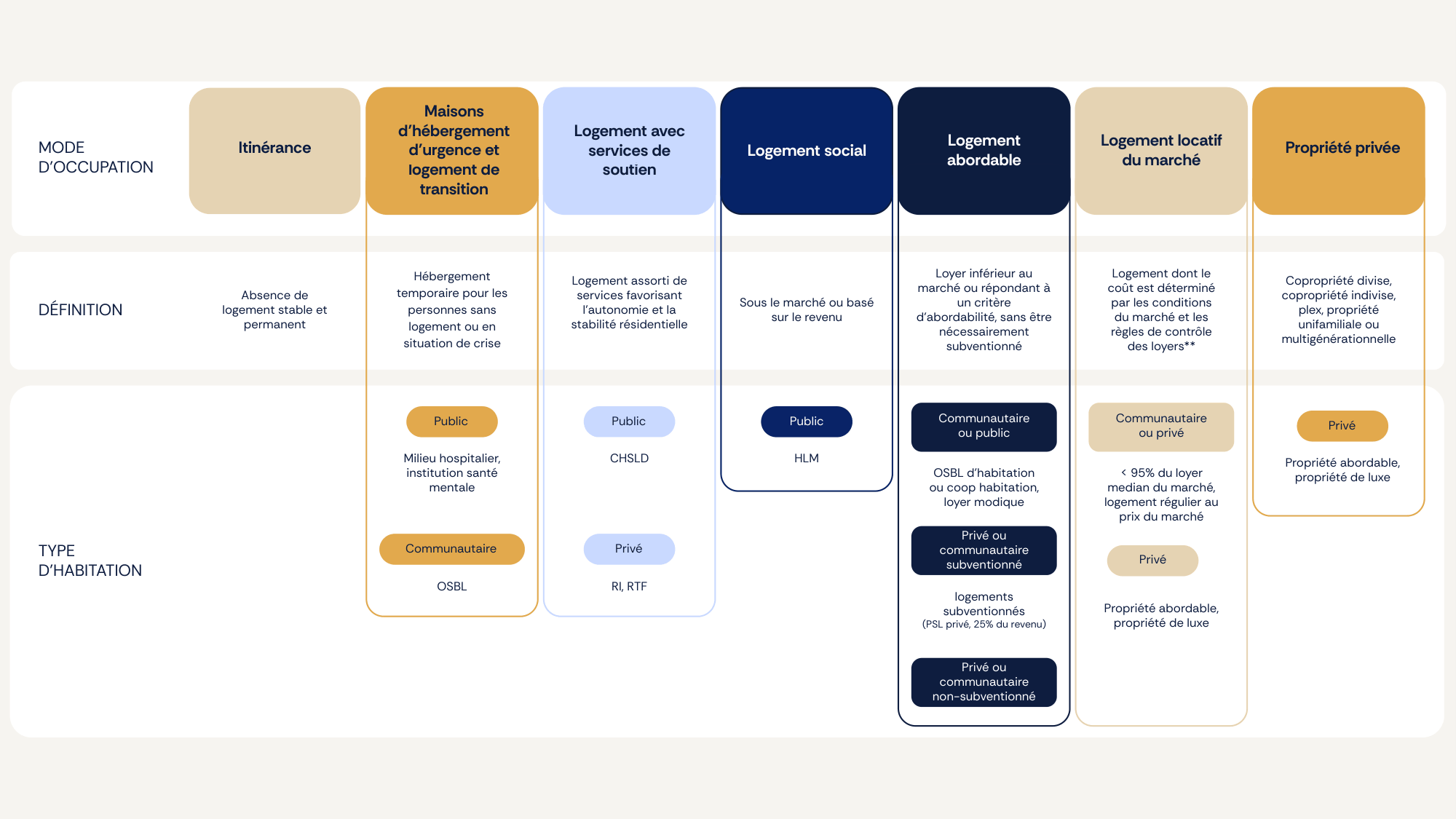
Note: This housing continuum is inspired by models developed by the Canada Mortgage and Housing Corporation (CMHC) and the CISSS de la Montérégie-Centre and adapted by CORPIQ (July 2026).
**TAL rent-setting grid, Section G of the lease, right to refuse, right to remain in the dwelling.

